

- HomeProducts
-

Inline vs Offline Selective Wave Soldering Machines: Key Differences
Views: 0 Author: Site Editor Publish Time: 2026-08-27 Origin: Site


Modern PCB assemblies pack densely populated double-sided SMT components alongside legacy through-hole parts. Traditional wave soldering exposes these mixed-technology boards to massive thermal shock and requires expensive custom pallets. Manufacturers hit a wall when scaling production because they must choose the correct deployment architecture for selective soldering. Pick the wrong system, and you end up with stranded capacity, wasted floor space, or massive changeover delays.
You must decide between integrating an inline selective wave soldering machine directly into the production flow or deploying an offline unit for decoupled flexibility. This technical evaluation aligns equipment capabilities with specific production volumes, product mixes, and facility constraints. We examine throughput dynamics, facility requirements, and integration realities to help you specify the right architecture for your factory floor.
Throughput vs. Flexibility: Inline systems maximize continuous throughput for low-mix/high-volume production, while offline systems offer superior agility for high-mix/low-volume environments, NPI (New Product Introduction), and prototyping.
Footprint and Line Organization: Inline architectures require significant contiguous floor space and dictate how the entire production line is organized; offline units are compact and operate independently without disrupting main line material flow.
Capital and Operational Costs: Offline machines present a lower barrier to entry (CapEx), but inline systems can yield a faster ROI at scale by reducing manual handling and labor costs.
Supplier Support is Critical: Beyond the hardware, partnering with a reliable selective soldering machine supplier ensures access to necessary tooling, software integration (MES/ERP), and long-term maintenance support.
The Baseline: Selective Soldering in Modern PCB Assembly
Traditional wave soldering relies on a massive, 2,000-pound molten metal bath. The machine pumps this heavy liquid metal to create a continuous wave. The entire bottom side of the printed circuit board passes through this wave. This process exposes the board to extreme thermal shock. It risks damaging sensitive surface mount components located near through-hole pins. Manufacturers must use expensive, custom-routed wave solder pallets to mask and protect these SMT components. This adds massive tooling costs and handling time to the production cycle.
Selective soldering solves these thermal and masking challenges. It utilizes a precision micro-wave of molten solder. A robotic gantry moves this miniature solder fountain point-to-point beneath the board. It targets specific through-hole components with pinpoint accuracy. This method protects sensitive SMT parts entirely. It eliminates the need for protective pallets. The precision nozzle only applies heat and solder exactly where required. This localized thermal application prevents board warpage and protects delicate intermetallic layers from excessive copper dissolution.
We define two primary deployment methods for this technology. Inline systems use conveyor-fed, automated flow to move boards through multiple processing zones. Offline systems operate as standalone units utilizing manual or batch loading into a single processing chamber. Integrating the right PCB soldering equipment determines your overall factory efficiency. You must match the machine's capabilities to your actual production floor realities.
A successful implementation meets strict performance criteria. It achieves zero-defect soldering across all through-hole joints. It minimizes cycle times to match factory takt time. It optimizes operator utilization by reducing unnecessary manual handling. It delivers a verifiable return on investment through reduced rework, eliminated masking costs, and increased throughput.
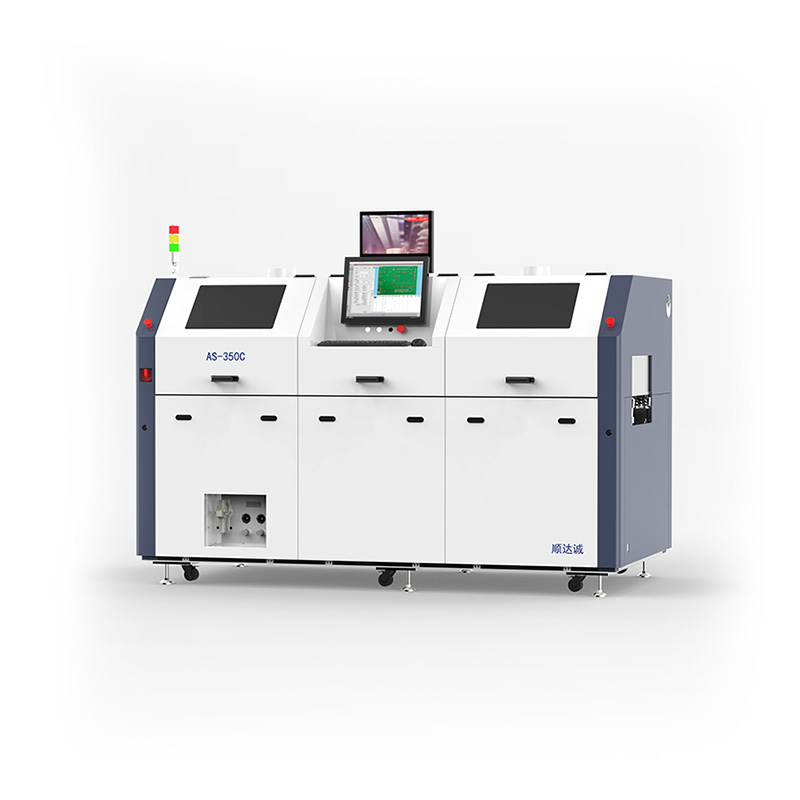
Anatomy of an Inline Selective Wave Soldering Machine
An inline system features a highly automated, segmented architecture. Board handling conveyors form the backbone of the machine. These edge-belt conveyors feature automatic width adjustment to accommodate different board sizes seamlessly. The system utilizes SMEMA or Hermes communication protocols. These protocols synchronize the machine with upstream and downstream equipment. The architecture relies on multi-station configurations. The machine separates fluxing, preheating, and soldering into distinct physical zones. Different boards undergo fluxing, preheating, and soldering simultaneously in these separate zones.
Continuous flow dynamics define the inline process. Boards move automatically from upstream inspection or placement equipment directly into the selective soldering process. No human intervention occurs during this transfer. A board enters the fluxing station where a drop-jet valve applies no-clean flux at high frequencies. It then moves to the preheat zone where infrared or quartz heaters activate the flux and soak the board. Finally, it enters the soldering module where a nitrogen-inerted micro-wave completes the joints. The conveyor then ejects the finished board to the next assembly stage.
This continuous flow dictates the organization of the entire factory floor. You must plan strict linear or U-shaped material flows. The equipment requires significant contiguous floor space. Upstream equipment must align perfectly with the inline machine conveyor height. Facility engineers must route exhaust ductwork, nitrogen lines, and power drops across a large footprint to service the multiple processing modules.
These systems excel in specific production environments. High-volume automotive manufacturing relies heavily on inline architectures. Consumer electronics production lines utilize them to maintain aggressive takt times. Low-mix industrial control manufacturers benefit from the continuous, uninterrupted throughput. Any environment running large batches of identical boards will maximize the parallel processing power of an inline setup.
Anatomy of an Offline Selective Wave Soldering Machine
An offline system features a standalone, compact architecture. It operates entirely independently from the main surface mount technology line. Operators load boards manually into the machine. They often place the PCB into a universal adjustable pallet. The operator then slides this pallet into the processing chamber and initiates the cycle. The machine processes these boards in batches. It utilizes single-station processing. Fluxing, preheating, and soldering occur sequentially within the exact same physical chamber.
Operational independence provides massive scheduling benefits. It decouples the through-hole soldering process from the main SMT line pacing. Complex through-hole soldering programs take time. If integrated inline, a slow soldering program forces the high-speed SMT placement machines to slow down. An offline selective wave soldering machine prevents the soldering stage from becoming a factory-wide bottleneck. You can run fast SMT boards continuously, stack them in magazines, and process them through the offline soldering machine at a different pace.
A robotic gantry inside the offline chamber handles all tasks. First, the drop-jet fluxer moves under the board to apply flux. Next, bottom-side heaters activate to soak the board and bring the flux to activation temperature. Finally, the solder pot moves point-to-point to solder the components. The operator waits for the entire cycle to finish before removing the board and loading the next one.
Offline systems shine in specific manufacturing sectors. Aerospace and defense contractors utilize them for high-reliability, low-volume runs. Medical device manufacturers rely on them for precise, traceable batch processing. Contract manufacturers with frequent changeovers prefer offline systems. They dominate proofing runs and New Product Introduction phases where engineers must tweak soldering parameters frequently without stopping main production lines.
Head-to-Head Technical Evaluation: Inline vs. Offline
Throughput and Cycle Times
Inline systems leverage parallel processing capabilities. Multiple boards exist inside the machine at once. While board A receives flux, board B undergoes preheating, and board C undergoes soldering. If each stage takes 60 seconds, the machine outputs one finished board every 60 seconds. This parallel processing maximizes continuous line pacing. It matches the speed of upstream automated equipment and keeps the factory moving.
Offline systems rely on sequential processing. A single board undergoes fluxing, preheating, and soldering in one location. If fluxing takes 60 seconds, preheating takes 60 seconds, and soldering takes 60 seconds, the total cycle time equals 180 seconds. The machine outputs one board every 180 seconds. Load and unload times further impact overall cycle efficiency. The operator must physically open the door, swap the board, and restart the cycle. This manual handling adds dead time to the production schedule.
Thermal Management and Precision Control
Inline systems utilize multi-stage preheating zones. They manage thermal profiles for heavy, complex boards without slowing down throughput. A thick copper backplane requires significant heat soaking. An inline system can feature two or three separate preheat modules. The board moves through these zones, gradually reaching the required top-side temperature. This prevents thermal shock and ensures proper capillary action during soldering.
Offline systems must execute the entire thermal profile within a single chamber. The board sits stationary while bottom-side heaters ramp up the temperature. This impacts per-board cycle time significantly. The machine cannot start fluxing the next board until the current board finishes its complete thermal cycle. However, this single-chamber approach offers highly customized thermal control per batch. Engineers can program unique ramp rates and soak times for highly specialized, low-volume assemblies without worrying about conveyor speeds.
Floor Space and Facility Requirements
An inline system demands a massive linear footprint. You must allocate space for the fluxer module, the preheat modules, the soldering module, and the connecting conveyors. This linear footprint dictates factory layout. Facility engineers must install extensive exhaust ductwork to vent flux fumes from multiple zones. They must route high-capacity nitrogen supply lines to the solder pot. Power requirements scale up due to multiple heating zones and conveyor motors.
An offline automated soldering machine features a compact, modular footprint. It occupies a fraction of the space required by an inline system. You can place it in a corner or against a wall. It requires a single exhaust drop and a single nitrogen connection. Power requirements remain lower because it only operates one set of heaters and one robotic gantry at a time. This makes offline systems ideal for crowded factory floors.
Labor, Automation, and Handling
Inline setups require minimal manual handling. Operators primarily monitor the equipment and perform routine maintenance. They verify flux levels, check nitrogen pressure, and ensure the solder pot remains full. This automated flow drastically reduces human error. It eliminates the risk of dropping boards or loading them backward. It also minimizes Electrostatic Discharge risks because operators rarely touch the physical assemblies.
Offline setups require dedicated operators for loading and unloading. The operator must handle every single board. This increases labor costs and introduces handling risks. However, this manual interaction allows for immediate visual inspection at the point of processing. The operator can inspect the through-hole joints as they remove the board from the machine. They can catch defects instantly before processing the next batch.
Tooling, Changeovers, and Product Mix Agility
Switching programs on an inline system involves significant complexity. You must adjust conveyor widths across multiple modules. You may need to physically swap out solder nozzles if the new board requires a different wave dynamic. During this changeover, the entire production line halts. Upstream SMT machines must wait until the selective soldering machine finishes its setup. This downtime destroys efficiency in high-mix environments.
Offline systems handle frequent product changes effortlessly. The operator simply loads a different board into the universal pallet. They select a new program from the touchscreen interface. The machine adjusts its robotic path instantly. You do not need to halt an entire production line to change a soldering program. This agility makes offline systems indispensable for contract manufacturers dealing with dozens of different assemblies per week.
Architecture Comparison Matrix
Specification
Inline Architecture
Offline Architecture
Processing Method
Parallel (Multi-board)
Sequential (Single-board)
Footprint
Large, linear layout
Compact, modular
Changeover Speed
Slower (Line halts)
Rapid (Independent)
Operator Handling
Zero-touch automated
Manual load/unload
Ideal Production
High-volume, low-mix
High-mix, low-volume
Cost-to-Value Analysis and ROI Factors
Initial Capital Expenditure (CapEx)
Inline systems require a substantially higher initial investment. You pay for edge-belt conveyors, advanced SMEMA automation, and multi-module physical setups. You purchase separate fluxing gantries, multiple high-density heater arrays, and a dedicated soldering robot. The installation costs also increase due to complex facility routing for exhaust and nitrogen. This high CapEx requires high-volume production to justify the investment.
Offline systems offer a much more accessible entry point. Mid-sized contract manufacturers can adopt selective soldering technology without breaking their capital equipment budgets. The single-chamber design reduces hardware costs significantly. You only pay for one robotic gantry that handles both the flux nozzle and the solder pot. Installation costs remain low due to the simple facility requirements.
Operational Expenses (OpEx) and Maintenance
Nitrogen consumption represents a major operational expense. Inline systems often consume more nitrogen because they maintain inert environments across larger or multiple soldering zones. Offline systems typically use less nitrogen, shrouding only the single micro-wave nozzle. Solder pot maintenance also differs. Inline systems run continuously, requiring frequent dross skimming and solder bar additions. Offline systems run intermittently, generating less dross over a standard shift.
Inline systems present higher maintenance complexity. Technicians must maintain moving parts across multiple zones. Conveyor belts wear out. Width adjustment motors require calibration. Drop-jet fluxers in station one require cleaning, while the solder pot in station three requires maintenance simultaneously. Offline systems condense maintenance to a single area. Technicians clean the flux nozzle and skim the solder pot within the same physical footprint.
Hidden Costs and Efficiency Leaks
You must identify easily overlooked costs when evaluating these architectures. Downtime on an inline system stops the whole line. If the drop-jet fluxer clogs on an inline machine, boards back up into the SMT placement machines. The entire factory floor loses throughput. Downtime on an offline system only stops that specific batch. The main SMT line continues running, stacking boards in magazines for later processing.
Factor in the cost of operator training. Offline setups require operators to understand manual loading procedures and visual inspection criteria. You must account for potential rework due to manual handling errors. Dropped boards or improper pallet seating can damage expensive assemblies. Inline systems eliminate these manual handling costs but require higher-level engineering support to program complex parallel processing routines.
Implementation Realities and Adoption Risks
Integration with Existing PCB Soldering Equipment
Integrating an inline system into a legacy SMT line presents physical and software challenges. You must match conveyor heights precisely. Legacy equipment may use outdated communication protocols, requiring custom SMEMA integration boxes to talk to the new selective machine. Line balancing becomes critical. If the selective soldering cycle takes 90 seconds, but the SMT placement cycle takes 45 seconds, the selective machine becomes a severe bottleneck.
You must calculate takt times carefully. If you cannot balance the line, you risk stranding capacity on your expensive upstream equipment. Sometimes, manufacturers must install dual-lane selective soldering machines or run two single-lane machines in parallel to keep up with high-speed SMT lines. This doubles the footprint and the capital expenditure.
Software, Traceability, and Compliance
Medical, automotive, and aerospace sectors demand strict data logging for traceability. Both architectures handle basic data logging, but inline systems excel at automated tracking. Inline machines typically feature integrated barcode scanners on the conveyor entrance. As the board enters, the scanner reads the 2D barcode. It automatically pulls the correct soldering recipe from the Manufacturing Execution System.
The machine logs the exact preheat temperatures, flux volume, and solder wave height for that specific serial number. It pushes this data back to the ERP system seamlessly. Offline systems require the operator to scan the board manually with a hand scanner before loading it. If the operator forgets to scan the board, you lose traceability for that specific assembly. Automated inline tracking eliminates this human error.
Mitigating Production Bottlenecks
Implement strict line balancing strategies to mitigate bottlenecks. Analyze the soldering program to find efficiencies. You can execute several tactical adjustments to keep production flowing:
Audit upstream SMT placement times to establish a baseline takt time for the entire line.
Optimize robotic routing paths in the soldering software to minimize non-value-added travel time between joints.
Implement dual-nozzle configurations to solder multiple connector pins simultaneously.
Buffer boards using vertical magazines to absorb minor cycle time mismatches between machines.
Increase the preheat temperature slightly to speed up capillary action during the soldering phase.
Consider adopting a hybrid approach. Use an inline system for your core, high-volume products that rarely change. Deploy an offline system next to it for NPI, low-volume outliers, and complex boards that require custom thermal profiles. This hybrid strategy protects your main line throughput while maintaining the agility needed to win high-mix contract manufacturing bids.
Decision Framework: How to Choose the Right Architecture
When to Specify an Inline System
Specify an inline architecture when your production environment meets specific criteria. Use this checklist to validate your decision:
Your facility maintains greater than 80% utilization of a single product family.
You operate in a region with exceptionally high labor costs, making manual handling prohibitive.
Your customers enforce strict no-touch handling requirements to prevent ESD damage.
You have available, contiguous linear floor space to accommodate multi-module equipment.
Your upstream SMT equipment outputs boards at a rate that matches parallel selective soldering cycle times.
When to Specify an Offline System
Specify an offline architecture when flexibility outweighs raw throughput. Use this checklist to guide your selection:
You operate a high-mix contract manufacturing facility with multiple daily changeovers.
You face severe floor space constraints and cannot accommodate a linear conveyor layout.
Your production schedule features unpredictable batch sizes and frequent prototype runs.
You handle heavy NPI and proofing requirements where engineers must tweak programs constantly.
Your through-hole soldering programs take significantly longer than your SMT placement cycles.
Future-Proofing and Scalability
Evaluate your potential to scale before making a final decision. Production volumes change. A contract manufacturer may win a massive, multi-year automotive contract that shifts their mix from low-volume to high-volume. Look for modular offline systems. Some manufacturers design offline chambers that can be retrofitted with edge-belt conveyors later.
You start with a manual-load offline machine to handle your current high-mix needs. As production volumes grow, you purchase the conveyor upgrade kit. Technicians remove the manual load door and install the SMEMA conveyors. Your offline machine transforms into an inline automated soldering machine. This future-proofing strategy protects your initial capital investment while providing a clear upgrade path.
Vetting a Selective Soldering Machine Supplier
Choosing the right vendor matters as much as choosing the right architecture. Look for suppliers who offer comprehensive time studies. Send them your most complex Gerber files and request verifiable cycle-time simulations. They should prove exactly how long their machine takes to process your specific board in both inline and offline configurations.
Evaluate their aftermarket support network. Demand local spare parts inventory. You cannot wait two weeks for a replacement drop-jet flux valve to ship from overseas. Negotiate robust Service Level Agreements that guarantee technician response times. Ensure you have direct access to application engineering support from your selective soldering machine supplier. Good application engineers will help you optimize your robotic routing and thermal profiles long after the initial installation.
Conclusion
Neither deployment architecture is universally superior. The choice is strictly dictated by your facility's volume-to-mix ratio, factory layout, and overall automation strategy. Inline systems dominate high-volume, low-mix environments where continuous flow and minimal manual handling drive profitability. Offline systems rule the high-mix, low-volume landscape where agility, rapid changeovers, and decoupled processing prevent factory bottlenecks.
Prioritize inline configurations when scaling massive production runs that demand parallel processing and automated MES traceability. Prioritize offline configurations when you need precision proofing, frequent program swaps, and a lower initial capital expenditure. Aligning your equipment choice with your actual production reality ensures maximum efficiency and a rapid return on investment.
Take the following steps to finalize your deployment strategy:
Audit your current product mix to calculate the exact volume-to-mix ratio across all active assemblies.
Measure available contiguous floor space to verify if a linear multi-module layout fits your facility.
Request verifiable cycle-time simulations from shortlisted vendors using your most complex Gerber files.
Calculate your average daily changeover frequency to quantify potential downtime on a continuous flow line.
FAQ
Q: What is the main difference between an inline and offline selective wave soldering machine?
A: The main difference is physical integration. Inline systems connect directly to the production line via conveyors for automated, continuous flow. Offline systems operate as standalone units requiring manual loading. This directly impacts throughput, factory organization, and labor requirements.
Q: Can an offline selective wave soldering machine be upgraded to an inline system later?
A: Yes, depending on the manufacturer. Some suppliers offer modular offline systems designed for future scalability. Technicians can retrofit these specific models with edge-belt conveyors and SMEMA communication packages, transforming them into inline systems as production volumes grow.
Q: How does product mix affect the choice of PCB soldering equipment?
A: High-mix environments suffer from severe downtime during changeovers on inline systems because adjusting conveyors and programs halts the entire production line. Offline systems handle high-mix environments efficiently because operators can swap programs and batches rapidly without disrupting the main SMT line.
Q: Why choose selective soldering over traditional wave soldering?
A: Selective soldering offers superior precision for mixed-technology boards. It features excellent SMT compatibility by targeting specific through-hole pins with a micro-wave. This eliminates the need to expose the entire board to a massive molten solder bath, drastically reducing thermal shock and eliminating expensive masking pallets.
Q: What are the maintenance differences between inline and offline systems?
A: Inline systems possess more mechanical parts, including conveyor belts, width adjustment motors, and multiple physically separated flux and solder stations requiring complex maintenance. Offline systems are mechanically simpler but require more frequent manual cleaning of the single, condensed processing area.
Q: How do cycle times compare between automated soldering machines in inline vs. offline setups?
A: Inline systems achieve faster per-board cycle times through parallel processing. They flux one board while preheating a second and soldering a third simultaneously. Offline systems process sequentially, completing fluxing, preheating, and soldering on a single board before starting the next.
Q: Is an inline selective wave soldering machine worth the extra floor space?
A: Yes, if your production volumes dictate continuous flow and the reduction in manual labor offsets the cost of the dedicated linear footprint. No, if your line runs small, highly variable batches where the inline machine would sit idle during frequent changeovers.


